01 / Discovery
Network.framework & Bonjour
The host advertises the kitchen on the local network, while the other devices discover and join the session without requiring an internet-hosted game server.
Case study / 04
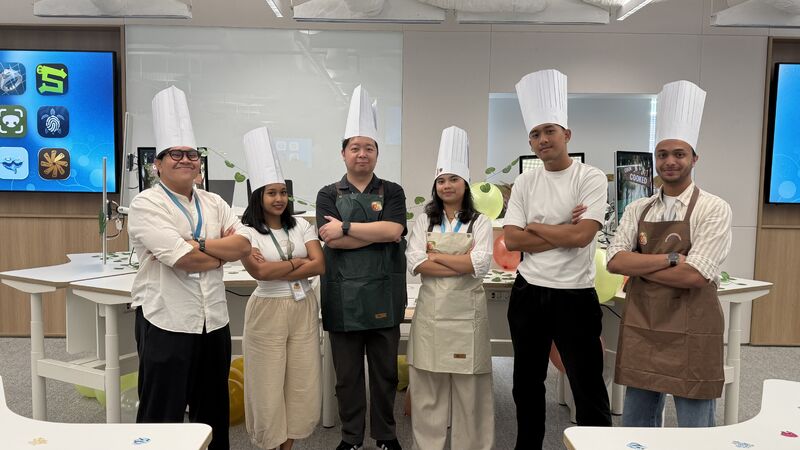
My team and I created a two-to-four-player local cooperative cooking game for Challenge 5. Inspired by the way board games bring people together, we designed the technology around face-to-face communication instead of treating local multiplayer as a smaller version of online play.
01 / My learning focus
The networking system was the most interesting and difficult part of the project for me. I learned how to discover nearby devices, form local connections, synchronize players and keep one authoritative source of truth.
01 / Discovery
The host advertises the kitchen on the local network, while the other devices discover and join the session without requiring an internet-hosted game server.
02 / Authority
The host tracks the timer, player positions, occupied stations, ingredients, utensils, recipe progress and the final serving action.
03 / Synchronization
Each client sends intent and receives state updates so all players see the same station availability, object ownership and recipe progress.
04 / Purpose
The system was deliberately local because the product goal was a shared-room experience. Technical architecture and social design pointed in the same direction.
02 / Product vision
We wanted the feeling of gathering around a board game: players should talk, divide responsibilities, laugh at mistakes and solve the challenge together. The local-network architecture exists to protect that social experience.
01 / Host
One player hosts the session and becomes the authority for the shared game state. Nearby players discover the room over the same local Wi-Fi network.
02 / Join
Players enter a four-digit code and, on supported devices, complete a Nearby Interaction check designed to keep the group within roughly eight meters.
03 / Communication
Once everyone is ready, the game assigns a Head Chef. Only that player can read the complete recipe, so success depends on explaining the plan clearly and coordinating the kitchen instead of simply following instructions alone.
03 / Core loop
The team must prepare a Strawberry Shortcake by moving through a shared kitchen, collecting ingredients and utensils, dividing work across stations and finishing before the timer expires.
01 / Plan
The Head Chef communicates the recipe while the team decides who should handle each station and ingredient.
02 / Gather
Players navigate the same kitchen, pick up tools and ingredients and avoid blocking one another’s work.
03 / Cook
Chopping, sifting, cracking, melting, mixing and baking become interactive device-based challenges.
04 / Serve
Everyone returns to the center and holds Serve together. The team wins only if the completed cake is delivered before time runs out.
04 / Interaction design
Core Motion, AVFoundation and Core Haptics turn actions such as shaking, blowing, tapping and moving the device into cooking mechanics. The minigames make each station feel distinct while giving teammates something visible and physical to react to.
The bugs and unreliable moments across multiple devices were frustrating, but solving them made the project meaningful. Cook or Cooked reinforced a lesson I care about: technology can connect more than machines. It can create reasons for people to communicate.