01 / Match shape
Duration, teams & difficulty
I balanced match length, player count and word difficulty so a session stayed competitive without becoming exhausting or ending before its tactical systems mattered.
Case study / 05
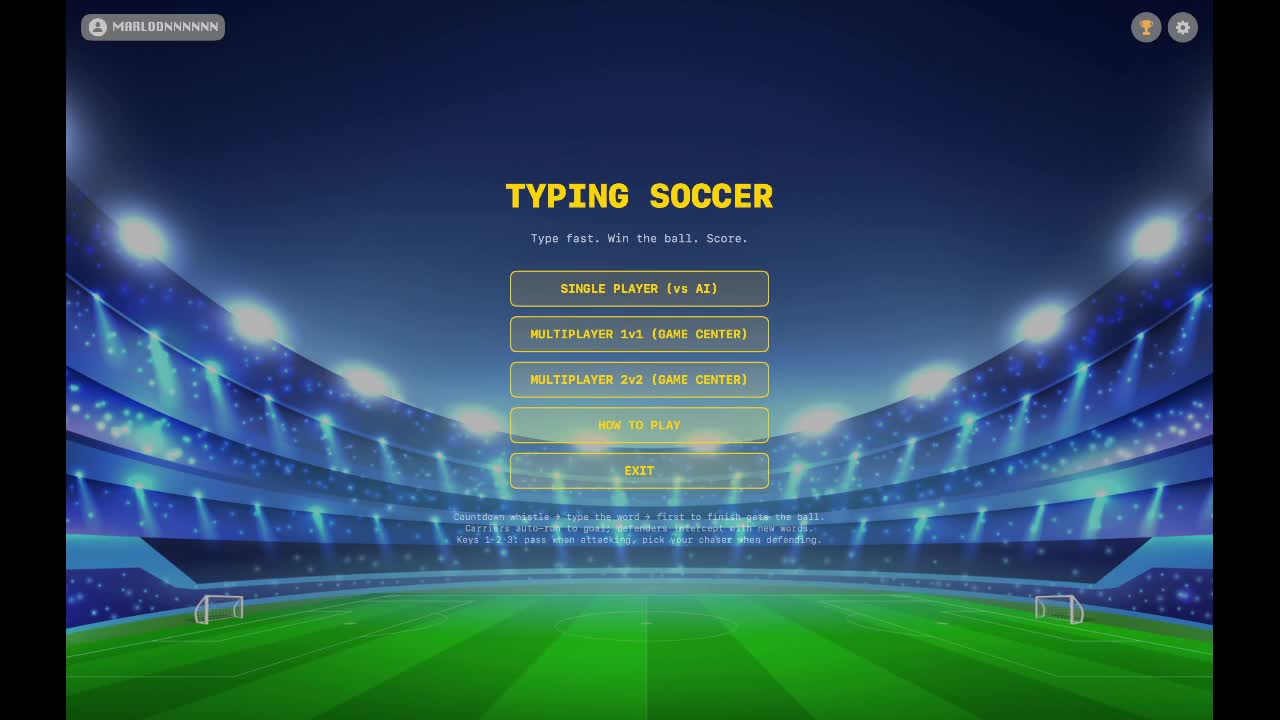
For Apple Developer Academy Challenge 4, my team and I built a macOS game where typing controls the match. I prototyped the idea, refined its mechanics and balanced the many systems that turn a typing duel into football.
01 / My contribution
My role was to establish the game idea and refine how it felt over a full match. That meant treating every rule as part of one connected pacing system rather than tuning features in isolation.
01 / Match shape
I balanced match length, player count and word difficulty so a session stayed competitive without becoming exhausting or ending before its tactical systems mattered.
02 / Movement economy
I refined movement speed, stamina pressure and passing behavior to make possession feel earned and to prevent one fast typist from flattening the team game.
03 / Match rules
I worked through edge cases such as tied scores, extra time and penalty shootouts so the match had a complete competitive arc.
04 / Authenticity
I collected football player data from FC Ratings and used names, speed and stamina attributes to influence how different players behave on the pitch.
02 / Core loop
The design translates familiar football moments into short competitive typing decisions. Every duel changes possession, position or scoring opportunity, so typing performance always has a visible consequence on the pitch.
01 / Kickoff
Every match begins with a word challenge. The fastest player wins possession and starts moving toward the opponent’s goal.
02 / Pressure
Defenders can trigger another duel to challenge the ball carrier and reverse momentum.
03 / Tactics
Passing, formations, positioning and stamina create decisions beyond raw words-per-minute speed.
04 / Finish
A final goalkeeper challenge converts the attack into a shot, a save or a goal.
03 / AI opponent
I developed the AI opponent around believable variation rather than perfect execution. Its timing and decisions create competitive pressure while leaving room for recovery, surprise and different skill levels.
01 / Typing model
The AI’s typing time is calculated from word length and skill level, then varied with randomness, simulated fumbles and occasional missed shots.
02 / Football behavior
Rule-based algorithms control movement, defending, passing and positioning, connecting the typing layer to recognizable football behavior.
03 / Resilience
If someone disconnects during multiplayer, the AI can take over that role so the remaining players can finish the match instead of losing the entire session.
04 / On-device coaching
I explored Apple’s Foundation Models for a post-match coach. The on-device model analyzes WPM, accuracy, mistakes, duel performance, goals and fastest words to explain strengths and identify what the player can improve.
A rule-based fallback produces feedback when the model is unavailable. The feature was designed so the learning experience remains dependable instead of making generative AI a single point of failure.